


Pascual Salvador
TrendsThere's a very strong trend in architecture and interior design in recent years, where materials regain full prominence, becoming elemental pieces when designing a piece or a room.
Materials seduce and shine on their own, without any embellishment or decorative excess. If, moreover, they are natural elements like stone or wood, the result is completely evocative.
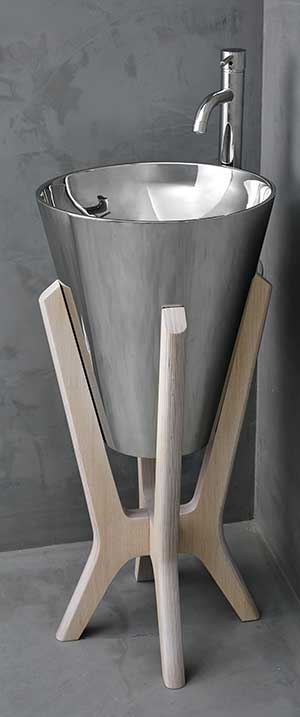 The designer's intention when planning the construction of a piece or the interior designer's intention when planning the layout of a room is precisely to highlight and emphasize the natural textures and shapes of these materials. To achieve this, they use very harmonious designs that seek to accompany or embrace that raw material which powerfully enters the room but, at the same time, brings harmony and balance.
This trend is not at odds with sophistication or luxury. In fact, incorporating metallic touches or materials often adds a touch of glamour and sophistication to any space. Steel, aluminum, or finishes ranging from gold to silver become the focal point or main element of a room.
We spoke with Pascual Salvador, a recognized architect and industrial designer who has made a name for himself in the world of product development and is part of the Council of several prestigious design associations, including ADI-FAD, BEDA, and ADP.
From his studies in Mexico and Barcelona, he collaborates with important national and international design firms. Among them is Bathco, with whom he has worked closely for years in the development of bathroom products. Some of his most recent designs can be found in the general catalog: the Munich and Bonn faucets, the reproduction of the Titanic bathrooms, Relief, etc.
The latest works developed for Bathco will be presented at Cevisama 2017, and the products that stand out have a common denominator: the prominence of the material.
What is the creative process developed in your Barcelona and Mexico City studios like, conceptual or formal?
Every project is born from intuition that invariably comes from one of two paths: conceptualization driven by functionality and innovation, or creativity that arises from a burst of intuition about forms, textures, or materials. From there, the essential skill comes into play: attempting to combine both concepts. In a context where it's possible to integrate both, I'm faced with a process that will very likely be the first step in incorporating all the requirements a product must have.
What peculiarities or aspects should be taken into account when designing a bathroom product, such as a cabinet or a sink?
Being realistic, I believe that, as with any project, it's a process of seduction through functionality and, at the same time, the aesthetic emotionality of an object that will inhabit our environment. It's important that, day by day, it continues to confirm its functionality and transmit that emotional connection that initially captivated us. Time and our relationship with it will tell us if it's a good product. It's essential for a designer that their proposal is intended for a more comfortable, more respectful environment, and that it helps our culture and quality of life evolve over time.
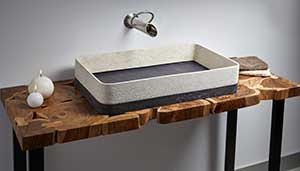 Stone Series expands its catalog with a family of stone sinks whose unique feature is the thinness of their walls. What is the creation process for a piece like this?
Stone, like all materials or any of us, has its own personality. You have to know how to treat it, and it's exciting to discover new possibilities. In this case, achieving certain profiles, defined by their visual lightness without losing their characteristics, was a laborious process, and here is the final result.
If something characterizes Solid Surface, it's its ability to be molded and create different pieces. What differentiates the new references from the previous ones?
It's always fascinating to have the opportunity to engage with new products like Solid Surface, where we find innovative technology with new possibilities for applying forms and concepts with surprising finishes, yet which at the same time become a challenge to work with due to their unique characteristics.
How does a material like concrete or terrazzo influence the design of new pieces?
I believe there is a cultural quality to materials, and we must try to harness their potential. Cement and terrazzo are two good examples of this, where very interesting applications can emerge. Trying to solve this has been a conceptually very satisfying experience.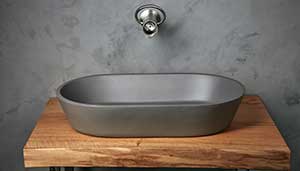
One proposal we're increasingly seeing in the interior design world is the application of zinc in bathrooms in the form of sinks. What do these types of pieces offer, both aesthetically and technically?
This is a concept committed far beyond what we might consider “traditional“ materials for a sink collection; it's something new, where I try to bring together new aesthetic and material concepts. Just take a walk down the street to see where aesthetic criteria are heading. Would we have believed a few years ago that a large part of today's personal aesthetic would be based on tattoos and wearing tight clothes literally ripped at the knees? I imagine many tattoos that will be in daily contact with these new products.