


Portuguese style
TrendsPortuguese architecture, like that of any other country, is marked by culture and history throughout the centuries, but there are local manifestations that make a place unique.
In the case of Portugal, Manueline architecture, known as the exuberant Portuguese version of Gothic, and the Pombaline style, a blend of late Baroque and Neoclassicism that developed after the Great Lisbon Earthquake of 1755, can be appreciated.
 It can be said that Pombaline (1755-1860) is the most characteristic style of Portuguese architecture due to its sobriety without ostentation. This spirit of functionality has extended to the present day and has been modernized to suit the interiors of current homes. To learn more, we spoke with Carlos Filgueiras, general manager of Aquafrigio, an official distributor of Bathco in Portugal.
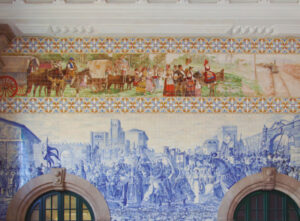
Filgueiras comments that “although the tradition of placing tiles comes from Arab influence, it is in the 19th century that its application begins to become more intense, due to the establishment of factories in Lisbon, Aveiro, and Porto. Tiles are found on the facades of private buildings and train stations, as well as inside more luxurious buildings, and can be seen as decoration in some entrance halls, on balcony walls with images of rural life.”.
In Spain, kitchens and bathrooms are the most suitable rooms for tiling. The same happens in Portugal, where “plain and less decorative colors are seen in bathrooms and kitchens to facilitate cleaning and provide a sense of hygiene thanks to the tile covering on the walls.”.
Regarding decoration trends, Filgueiras comments that “classic canons are currently maintained in renovation and remodeling projects, respecting old patterns and measurements. In new buildings, larger tiles are usually installed, resulting from an evolution in manufacturing processes.".
The CEO of Aquafrigio comments on the importance of sanitary ware in a typical Portuguese home. “In the main bathroom of the house, a toilet with a floor outlet tank, bidets, sinks, and a bathtub are usually installed. The trend for the last 20 years has been the installation of toilets, bidets are used less and less, sinks with cabinets are usually installed, and bathtubs are replaced by shower trays.".
 Whereas in secondary bathrooms or powder rooms, the toilet and sink are usually installed as the main pieces, focusing on design, material – stone or aluminum – and even decoration.
We also asked him about other materials traditionally used in Portugal, besides tiles. “In interior decoration, wood is predominantly used. In the 19th century, the most luxurious rooms used this material for flooring, as well as in dining rooms and hallways where half the walls in dining rooms and hallways werePaneled. The ceilings were decorated with fine woods imported from Brazil and Africa.”.